
2019 To Mongolia and back, mostly by train
2019 Iron Road Silk Route
We decided that we wanted to go on the Trans-Siberian Railway not long after we were married, and then, a few years ago, on one holiday, we started talking about the next – as we usually do – and made an order the trips we’d do over the next years – these would be South America, then New Zealand, then Africa and then Trans-Siberian Railway.
As you already know, this had all been put back a year due to the Land Rover incident. But we kept to the order – just a year behind.
As I get older, I start to panic that I won’t be able to do all the things that I want to do before I’m incapable – or dead. There is a sort of urgency that freaks me out. I know that some people have no desire to travel, and some are happy to go to the same place every time, but I love to be on the move all the time – seeing new places, meeting new people, experiencing new lands.
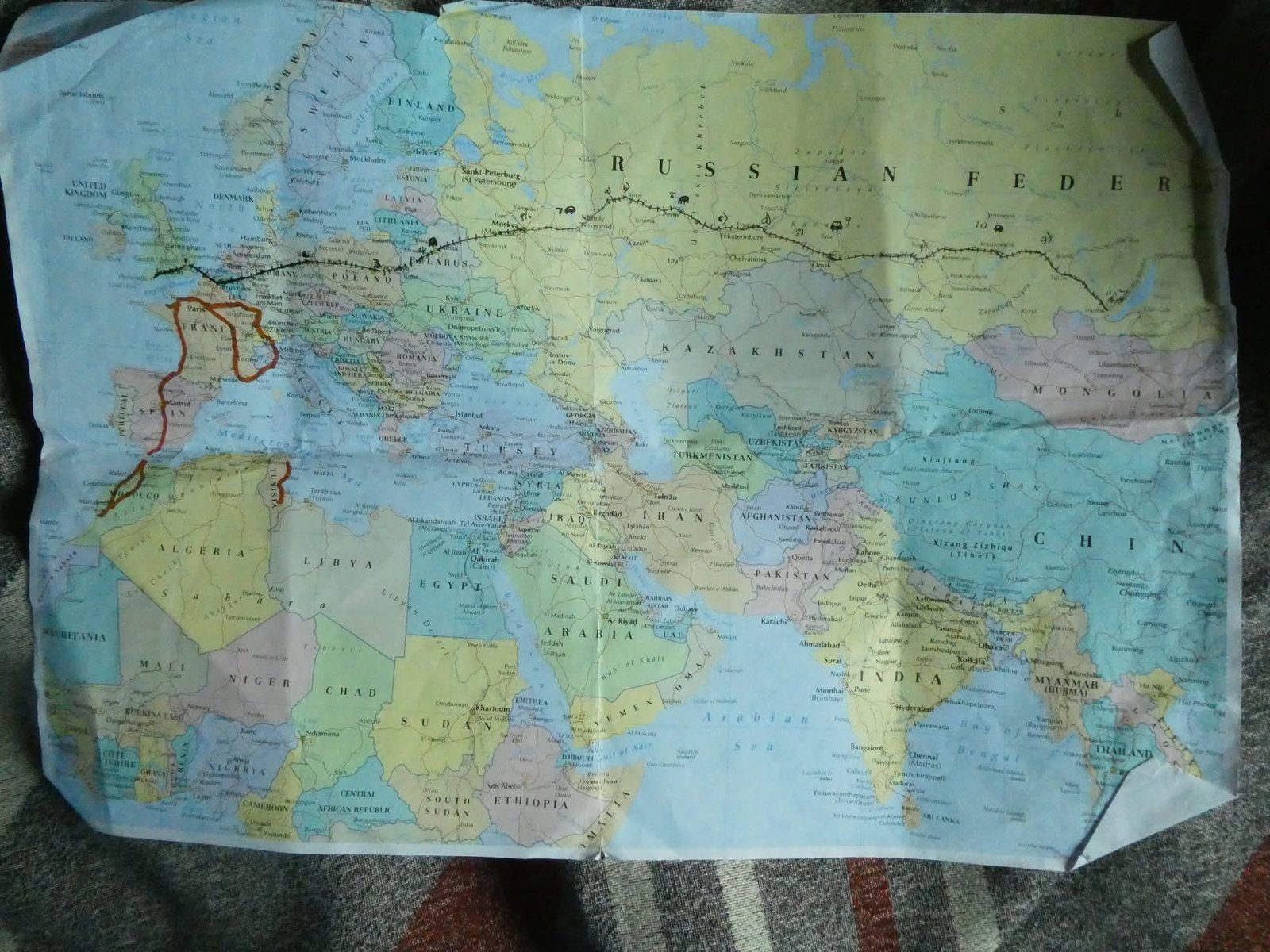
The plan was to do the whole trip – to Mongolia and back – by surface transport. No flying. Mostly train, a few cars and we’d probably have to do a bit on water too. The sticking point would be getting back across the Caspian Sea. We couldn’t go back through Russia, as our visas would be single entry, we looked into coming back via Iran, but that would mean travelling through Turkmenistan and they are notorious for just shutting the border or not letting people through for no reason at all and with no warning, and we didn’t have time for that, so the only other option was to catch the cargo ship across the Caspian.
Organising this trip was rather more complicated than some of our adventures have been. For Peter it was virtually a full-time job for a few weeks. You can’t just rock up in Russia or China, and you can’t just buy a visa in a matter of days.
For our trip we need four visas – Russia, China, Mongolia and Azerbaijan. The latter two can be done online, but for Russia and China, we had to present ourselves at the respective embassies for fingerprints and interviews etc. Total pain in the arse – I had to ask for a day off work – unpaid – and, of course, there was the cost of the train. Collecting the visa felt a bit cloak and dagger, too. We met a woman from ‘Real Russia’, the company that helped oil the wheels, on the pavement, who gave us our passports back and I half imagined Russian spy music to be playing in the background.
We had been going to China primarily to see (or look for) snow leopard, red panda and Pallas cat, as well as a good number of birds. In order to get the Chinese visa, you have to book every place that you are going to stay, so Peter put a lot of hard work into organising this part of the trip. We’d both been learning a bit of Mandarin, too. The rules for the photographs were very strict and the accompanying form that had to be filled out required more information than on a CV if you were applying for a job; a four-page questionnaire including education past high school, jobs and previous jobs and employer’s details and address of parents and children. I was surprised that they didn’t ask for the colour of my sister’s knickers! We got the Russian visa, but the Chinese one was taking too long and Peter needed his passport back for a job that he had to do before we went, so, devastatingly, we had to knock China on the head.
At least we didn’t have to continue trying to learn Mandarin – it’s so difficult. I concentrated on Russian and by the time we left, I could touch type the Russian alphabet on my keyboard, I could speak a few phrases and I could read Cyrillic, even if I couldn’t understand what it meant. This was actually very useful not only in Russia, but Mongolia, Kazakhstan, Uzbekistan and Kyrgyzstan, when it came to reading maps and road signs. And a few menus.
We took the train from less than a mile from our house, up to London, on the Eurostar and through Berlin and onto Warsaw.
We walked to the old town – which isn’t old at all really – rebuilt since being totally demolished in the war – but quaint nonetheless – and ‘did the tourist thing’ for about an hour, and, feeling thirsty and having seen a ‘craft beer sign’ we sought it out and followed the instructions to go down a back alley where we discovered – Heaven!
We spent a few happy hours sampling their delicious wares at M and chatting to Malvina and ……….. before asking them to get us a taxi – which, in retrospect was someone’s young brother in his own car – but he got us back to the shopping centre in time nonetheless, complete with a sample glass that they had given us. Great. We now had to carefully transport a glass through about twenty countries in three months. Even worse than ‘Plant’ who made it back – in one piece – from Vietnam. But maybe not as tricky as the two large wine glasses that we’d brought back from California – at least we weren’t camping.
We went into the supermarket that we’d previously identified and, despite our quality liquid lunch, we managed not to miss our train to Moscow which we boarded the train and got ourselves settled into our cabin. We then watched the world go by, had a doze, prepared for bed – which was the top bunks for us since we had the carriage to ourselves and so kept ‘downstairs’ for sitting in.
We had bought smoked cheese and very nice bread and tomatoes. We had our own sink under the table and the one of the loos had a shower which I didn’t bother using as there would be plenty of opportunities to try out an on-board shower on our next, much longer train ride (how wrong I was!)
Our first night was very fitful and rocky and neither of us slept well – I do love sleeping on the train, but this was quite a bumpy ride. Of course, part of the disturbance was also due to entering the Russian State of Belarus where we had to hand over passports with visas and fill in immigration papers. It’s always unnerving when they take your passports away and equally unsettling when they spend ages studying your documents – has everything been stamped properly by the relevant authorities? Does my signature look like my other signature? (Not usually, no!). Does the photo on the visa look like me? Also, thankfully, no! The photo for my Belarus visa is the same one we got for our Chinese visas and they are extremely strict on how one looks – and it’s not at all a good look!
Then, of course, came the changing of the bogies – a noisy and long-winded affair which, if you’ve never seen it done before is fascinating. The first time that we encountered this was on our way into Moldova some years ago. Still, we had some sleep and in the morning a lady came around to tell us that there was now a restaurant car and would we like some food – so she brought us tomato omelette and coffee. All very civilised really.
We arrived in Moscow about 12.30 on Friday – A weekend break in Moscow – three whole nights and three full days as the train doesn’t leave until half eleven at night. Marvellous. We got a taxi to the hotel – the Elysium in Pushkinskaya, sorted ourselves out and went for a walk to Red Square. We’d seen quite few police and soldiers – the latter in blue fatigues – on our way there. The previous Saturday there had been demonstrations by protesters (illegal gatherings as far as the authorities are concerned) and it was anticipated that there would be more this Saturday. There was a lot of police presence and ranks of metal barriers which I pointed out to Peter as possible evidence of another event the next day, but he said that they are probably just being stored there.
We walked to St. Basil’s, had the obligatory pics, walked around it, into GUM – the mahoosive department store which put me in mind of the Venetia Hotel in Las Vegas – high walkways and masses of international ‘quality’ brand named shops. We looked around for a beer but everyone seemed to be eating ice-cream and the place was heaving. I also refused to pay to go to the loo in such a place, so, having ‘done’ GUM, we left and had a walk around The Kremlin trying to work out a) how to get in and b) how much it cost. We decided to come back the following day to do a bus tour and the Kremlin. We walked back up the main street – where cars and motorbikes appear to be under the impression that it is in fact not a main city street, but a race track, and found a place to have an evening meal, which we did after a shower and change. We had an earlyish night, watched part of a film in bed and caught up on a bit of social media.
The following day, we got up quite late, had a shower, got dressed and went to the little place next door for a coffee and to get some laundry done. At a dry cleaner’s! It was the only place available and Peter needed some shirts, so it cost us about 2,500 roubles – about thirty quid! Yikes! Then we walked down to Red Square Walking down our short street, under the arch and into the main drag it became evident that it was more than just a bit of security.
There were huge numbers of police and army and a great many normal ‘town’ buses parked up along the street, which, on closer inspection inside – as there were blankets at the windows – were absolutely chokka-block with soldiers. We saw this all day and they must have been sweltering and cramped in there – no doubt part of the plan as they would have been like cooped-up angry dogs on their release!
Down at Red Square, we caught a sight-seeing bus which was massively expensive, but since there were three routes that you could do, could hop on and off at will and the ticket lasted 48 hours, we decided it would be a good way to see the city and get about. We started off on the ‘red’ route – around the town and Kremlin – plugging in the earphones to hear the on-board commentary.
Our first bus was fully closed in, so when we got off that one and onto the ‘Soviet Era’ orange route, we chose to sit outside. We had had to wait about half an hour for the change of bus due, apparently, to the ‘event’ that was going to occur. Choosing to sit outside was a bit of a mistake as it started to rain, but we had Peter’s ‘wet weather’ to cover us both – especially from the torrent that poured down from the reservoir on the roof every time the bus went round ‘the wrong’ corner.
Again – everywhere were police, soldiers, buses full of soldiers, ‘black Mariahs’ and cars, sirens blaring through the town. The girl on the bus had said that we could get off at the stop close to our hotel, but as we approached it, she said that she didn’t think that it would be possible because of the police. We had a few anxious moments as each time the driver tried to stop the bus, the police moved him on – the barriers were now all along the edge of the pavement making it impossible to get onto the pavement without jumping the barriers – despite the fact that people were going about their normal business on the pavement side of the barrier!
Eventually, and fortunately – since staying on would take us on a second trip of ‘The Soviet Era’ – something that we weren’t especially keen to do as the monotonous Asian/American voice that had accompanied us on this route was almost impossible to follow, unlike on the ‘red route’. We got off the bus and walked back to obediently use the subway to cross the four lanes of traffic but were turned back by a flank of soldiers guarding the subway. We pleaded with him to let us down as our hotel was just on the other side of the road, but he wouldn’t yield to our pleas and insisted that we go back up the road, whence we’d come, and cross there – which we did – and no one stopped us ‘jay walking’ – as they’d say in the USA!
On that side of the road another, more amenable soldier, after more pleas, allowed us to get to our side of the road and we realised that we were right in the middle of the ‘meeting’. ‘Stuff’ was happening on the side we’d just come from and we watched from the safety of our side of the street – along with many others – as individuals were followed, arrested and escorted to waiting buses.
‘We’ve got to see this’ I said to Peter. ‘This could be history in the making’.
With that – we went back to the hotel, collected our millionaire’s laundry, had a quick wee and dashed out again to watch the goings on.
We looked on awhile from the safety of our side of the road and noticed that there were lots of ‘bystanders’ standing by and watching on the side where the ‘action’ was. Not wanting to miss out, we went down the Metro steps once more – this time allowed through – as many others were being allowed to go about their business, and emerged from the steps on the other side into the centre of – whatever was happening – and beside one of the police vans.
We observed, in amazement, as groups of four or six masked police wandered purposefully around the crowd, appeared to pick on some poor soul at random and arrested him. (I say ‘him’ as, we learnt later, that after the violence of the previous week, they had been instructed not to be so heavy handed and that they weren’t arresting women or ‘old people’)
We closely followed each group of policemen who, like lions, were stalking their prey and we – press and others – followed like hyenas safe behind our camera screens.
We met one woman who had travelled to the area to be part of the meeting. She told us that anyone could be arrested but that we probably wouldn’t be as we were clearly English and that it would be ‘too much hassle’ for the police to bother with us.
Then we met Matthew Luxmore, an English journalist – who said that he wouldn’t be there without his yellow vest and that the police were likely to arrest just anyone.
We were also interviewed by ….Media – another of our ‘holiday film crew encounters’. They asked us how we felt as tourists witnessing this.
It was all very surreal the way the police scouted, hunted and picked out their prey before arresting them, mostly totally without resistance and then put them in a van or kept them on the other side of the barrier waiting for the next van to arrive – just like waiting for the next bus.
It started to get a little more tense and the army were linking arms on one side of the gathering – which was around a grassy hillock which was itself surrounded by seating. Many of those arrested were merely sitting on this seating area and every now and again, especially as someone was being carted off to the bus, one person would start a particular type of clapping and others would join in. Very strange, also, was the way in which we were able to point the camera in the balaclava-ed faces of the police and ‘Cosmonauts’, as these army bods were apparently known.
Whilst chatting with Matthew, we became aware that the arm-linking Cosmonauts were advancing on us and, with the barriers by the road on one side and the buildings with the entrance to the Metro on the other, the only ‘soft side’ was towards the restaurant where we had intended going for a beer.
‘It looks like they’re going to start kettling us’ I said to Peter. ‘I think that it might be time to go to that restaurant’. It might have been quite exciting to finish up in a Russian gaol for a night or so. We’d been told that that would be all that would happen to those who were arrested, but we had a train to Mongolia to catch and we didn’t want to miss it.
In front of this, there was a row of soldiers and as we approached, they closed ranks and refused to let us through. They pointed towards the Metro entrance and gave us instructions in Russian.
‘But our hotel is over there!’ We insisted. They refused to let us pass.
Peter moved forward, between two of the soldiers and towards one who was standing behind them and demanded to know, in English, who was in charge and why couldn’t we go to our hotel. The soldier at the back, presumably of a higher rank and not wanting any bad publicity for tourism, reluctantly waved us through.
All the while, a helicopter hovered overhead, repeating phrases through a megaphone. We asked one of those at the meeting what was being said and it was, apparently telling people that the soldiers are their sons and brothers and to respect them. There were also a few drones in the air. It was a bit like being on the set of a dystopian film.
Having got out of a potential kettling, we went to sit on the terrace of the restaurant, and ordered a beer to enjoy a ringside seat for any further happenings. There we met Vladimir Ivanovich who had come in six kilometres roller skates in order to see ‘the meeting’ – because his wife was away! We chatted a while and then all went inside for something to eat and to chew the fat.
Two left boots
On the Sunday, we’d discovered that a friend was staying in Moscow and had made a vague arrangement to maybe go across town, meet up, have a beer or three and a meal. Thankfully, he made other, family plans at the last minute.
We travelled around the Metro a bit, looking at the wonderful stations for which Moscow is famous, and visited Victory Park and imposing park with imposing statues and imposing buildings. A lot of Moscow is imposing.
We returned to our hotel and after showering, changing and coming out again, we were pondering a menu over a relaxing beer.
‘Just double check the time of the train’ I said, remembering a few instances in the past where we’d been out by a day – we lost a day in Morocco, and caught a boat by the skin of our teeth and forgot our ‘contingency day’ in India and had an extra day.
Peter got out the tickets and studied them.
We knew that we were leaving on Monday. We also knew that in order to be on time we had to be at the station at 11.35PM – so we had thought that the train was late Monday night. It wasn’t. It was at 12.05 Monday morning – so we had to be at the station late Sunday night!
We had a very good meal – Café MyMy has an extensive ‘menu’. Self-service but a huge variety – went back to the hotel via ‘Spar’ for some wine and vodka and ‘our local’ for some other bits and quickly packed. We checked out and took the Metro to the railway station and had to wait for about three hours before boarding the train.
The station wasn’t at all obvious – bearing in mind the fact that there are three stations in the same area – and when you get there there’s nowhere to sit. I haven’t mentioned the weather much, but it was pretty chilly in Moscow – unlike Warsaw – and we didn’t want to sit on a freezing platform – and neither did anyone else. So, we sat in ‘Burger King’, had a couple of vile ‘gnat’s piss’ – before a couple of Russian men sat beside us with dark beer.’
‘Where did you get those from?’ we asked. They showed us and we bought two much more lovely pints and nursed them until 11.45, chatting with our new friends. We then went to stand with all the other potential passengers, until everyone got up as the sign showed that we were on platform 3. We walked the long walk to carriage 7 – a journey reminiscent of our travelling in India thirteen years ago, only this time we didn’t have a ten-year-old complete with his own rucksack to ‘help’ along the way. We showed our tickets, had that excruciating scrutiny moment and got on the train.
Our compartment, number 6, was locked. People were coming in and we had to drag our bags into the adjacent cabin so that we weren’t in anyone’s way – until, of course, we were in the way of the people in number 5! Eventually a girl – for that is as old as she appeared – appeared. With a key. We got in, Peter spent some time ramming our belongings into the cubbyhole above the corridor and we waited to see who our travelling companions would be. Before long a woman and a man – about forty-five years old – came to claim their patch. We thought at first that it was to be these two, but it turned out that the man was just seeing off ‘his friend’ and she was in the bunk under Peter. Her name was Eena and she put her things away and, as no-one else appeared to be on the fourth bunk, a few things were dumped onto that.
We rammed our ‘food bag’ under Eena’s bed and we all started to make beds and settle in for the night. Tricky. Cramped. Cosy. Intimate. Eena, Russian with no English, and us, English with no more than a few Russian words.
In the early hours, as it became light, I woke – quite a good night’s sleep for me – and heard a knocking at the cabin next door. Then a knocking on our door. It opened and, pretending to be asleep, I watched through my fingers as a little lady bustled in quietly, had a look at the number in the cabin, the number on her ticket and declared ‘harashow’ – ‘good’.
She had with her an enormous parcel. In she came and seemed confused as to where to put the largest of her belongings. She kept looking up at the cubbyhole, but even if it had been empty, there’s no way that she could have got it up there – unless, of course, it was an empty box.
She called the Provenitsa – lady – or ‘girl’ in charge of the carriage and they had a little discussion before it was evidently decided to leave it on the floor where it was. She quietly got herself prepared for bed and retired to the bunk below me.
How to book a four birth with strangers
If you know that you are going to be sharing your train cabin with strangers, you need to book the right berths. We discovered, too late for a couple of journeys, how important this is.
The best combination is one up and one down. If you are both on the bottom bunks this might seem like the most convenient option, but it means that you have to vacate your bed and share it with your new companions until everyone want to go to bed. It also means that you can’t have that little nap that you promised yourself. You have to sit up all day. If, as we did on our four-night trip across Siberia, you have booked two top bunks, thinking that you’d be nice and private up top, you have to share ‘downstair’ with the incumbents, or, in the case of one of our cohabitants, who pretended to be asleep the whole time, not get to use it at all.
There was a restaurant car, so we spent most of the time in there, but had to ask the ‘awake’ woman to budge up so that we could use the little table to eat our picnic. No, the best combination, if there are two of you, is one up, one down. You can nap up top if you want to, and have the luxury of choosing whether to sit by the window, the only ‘discussion’ on that being between yourselves.
Sleeping on a train – Rocking back and forth like a baby in a pram – Sometimes mother pushes you over cobbles, violently drags you up and down stairs and then over some grass. Sometimes she pushes you down a smooth pavement, meets a friend and gently rocks you back and forth as she chats, lulling you back to sleep. She finishes nattering and off she goes again, running late maybe, swerving at the last minute to dash into a shop, the centrifugal force pushing your side against the pram to wake you briefly as you wonder what is going on before you drift off once more. You go to sleep stationary in the shop and wake again to find yourself rocking once more – or the other way around. Bang – she’s in a crowded market and your pram is pushed and shoved, but you
can’t see any of what is going on as you are tucked up warmly in your snug cocoon – a bed on wheels. Such is the nature of sleeping on a train for an adult. It is
Bliss!
Life on The Trans Siberian – Arrive, find the door is locked and get in before your co-inhabitants. Get the luggage hoarded in the cubby hole above the corridor and make the bed. Stash the bag of cheese, biscuits, packet soup, pot noodles and other health giving sustenance such as wine and beer – all the essentials for travelling for four nights and four days in a cramped compartment with two strangers. Time for bed involves the final visit to the toilet – a European set up, with clanky mechanical flush – looking more like something that belongs on a pre 1940s tractor than a toilet. A sink – hot water is apparently available in a hot water tank above the sink is not available – cold water comes out of a central tap (the others don’t work) which you discover is actually a functioning fawcett only by trial and error – ‘surely there must be water in here now!’ You have to hold a ‘stick valve’ up as water sprays around it – and the moment that you let go the water flow ceases. Slightly inconvenient for all over body washes – which is all you’ll have for the next four days. You retire to bed, hauling yourself into the top bunk – if that is your allocated position – and tentatively manoeuver yourself around between the bunks – one foot one side, one the other, to perch on the edge, hoping that the train won’t lurch at just the wrong moment and send you crashing down to the carpet – vacuumed every day for your comfort – breaking teeth, neck and dignity. Once on the bed, if you haven’t already, you perform a mild circus act of undressing and redressing in a small space akin to that of a two man tent, but with strangers below and a mirror on the inside of the door to make sure that neither you nor the stranger need miss anything, should you choose. The heat in the cabin is sweltering due to heaters – it’s cold outside – and sleep is not easy due to this. If it were hot outside you may be forgiven for thinking that the air conditioning had broken, but it is kept at this temperature. Who knows why? A fitful night’s sleep for anyone who, like me, needs to ‘get up in the night’ as this requires climbing up and down in the dark and walking up to the nearest loo, possibly only to find that this one is occupied and so you have the option of waiting or going to the one in the next carriage which requires opening a door into the ‘bit beyond the corridor’ where the doors to the platform are, opening the door to the ‘bit between the trains’ where the scary ‘plates that move’ grind over one another as the track rushes by beneath – where gaps are large enough to lose a toilet bag to the Russian tracks – opening the partner of this door to the next set of platform doors and, finally, the door into the next carriage. Well, not quite finally as the neighbouring toilet door also has to be opened. A total of eight doors in all – just for a midnight wee – and the same on the way back! And all over again the next time you wake! Woe betide anyone who wishes to embark on this procedure anywhere near or during a stop, however, as the toilet door is likely to have been locked. Some of the toilets have signs telling you not to put paper down the pan and provide a ‘receptacle’ which, in most train toilets would be just for paper towels, but in these are for ‘used’ toilet paper. Some don’t have these, or the signs, so, judging by the splatter of toilet paper all along the sides of the train and up the steps into the carriages and on the handles of the carriages plenty finds its way out of the train. And if the paper is on the train, steps, track and door handles… Night time involves hurtling, pootling, stopping, starting, standing for what seems like hours for no reason and picking up passengers who – if you have an empty bed in your cabin, may well be joining you along with chatting to the attendant and trying to work out where to put all of their ‘stuff’. Making bed and preparing for bed. If you’re lucky, you’ll drift off again whilst all this is going on. If crossing a border, you are as likely to have guards, soldiers, police etc. checking passports taking passports, inspecting passports and visas and stamping same. If going from Belarus to Russia, Mongolia to China or Romania to Moldova, you will also encounter extra banging, clanking, shouting, pushing and shoving of the carriage as it is taken into a side shed, lifted hydraulically off its bogies and has new, different sized bogies put in place. In the morning, the ablutions are repeated – an all over body wash this time – a bit like a self-inflicted elderly lady’s bed bath but without the benefit of a bowl of steaming water. Back to the cabin and ‘upstairs’ to wrestle with some ‘fresh clothes’ – i.e. the daytime pyjamas as opposed to the night time pyjamas, which you didn’t wear anyway as it was too hot. Instead you ‘wore’ a damp flannel placed, sporadically, on different parts of your ‘naked body to help keep the temperature down. At this point, you thank your lucky stars that you are ‘upstairs’ rather than ‘downstairs’ as the stranger on the bunk below has no such ‘privacy’! What to do now? The first of four whole days in this small, snaking world. First – try out the restaurant car – if you’re lucky it’s not too far away as the ‘door ceremony’ will have to be performed between each carriage. Going up the train, each carriage has its own ‘character’. There’s ‘shoe carriage’ where the low radiator below the corridor window is one long line of trainers – for some reason, this trend hasn’t caught on in the other carriages. There’s ‘carpet carriage’ which has a nice carpet which, for the first day was half covered in a rag/sheet – but clearly they gave up on that idea as it spent most of its time shoved to one side and ‘posh carriage’, which is just slightly more modern. And then the restaurant car where such delicacies as vegetable stew, Greek salad, borscht and fried potatoes, mushrooms and onions await. You know that it’s the restaurant car from the stewy smell emanating from the behind the final door. And, of course, booze. Lots and lots of booze. Let’s face it, there’s little else to do in the train besides eat, drink, read, sleep, snack, drink, read, update a diary, drink, sleep and, of course, watch out of the window. For hours. And hours and hours. It’s great though! A time to reflect and, due to lack of technology, read, chat and play games. It is cramped – it’s all cramped. The cabin, shared, as is likely, with strangers – and their ‘stuff’ – some are ‘locals’, i.e. Russians – travelling the length and breadth of their country to visit friends or go home laden with purchases perhaps not available at their destination. Huge purchases. One wonders how an old lady with a box that appears to house a 63″ TV screen was expecting – or expected – to get it into the overhead cubby-hole. (She didn’t – it takes pride of place on the floor by our shared table which we get to use as we need it for our bread and cheese and Potnoodles). Four in a cabin – technically ‘downstairs’ residents get the window seats and upstairs tenants, the other two. In practice, ‘downstairs’ tend to kip on their beds for most of the time which means that the only places to go are ‘upstairs’ standing in the corridor to look out of the window there, or ‘out’, as we call it – i.e. the restaurant car. The corridor is cramped – traversing it regularly means regularly squeezing past others, saying ‘spaceebo’, ‘dankeschon’ or ‘merci’ – and, occasionally ‘thank you’. If you have a ‘device’ you have to rely on your own Wi-Fi, as there is none on board. When the juice runs out, you need to plug into one of the three sockets in the carriage (not counting the ones in the loos, but only a madman would leave their precious phone, tablet or laptop charging in one of those!) But finding a free socket is a challenge in itself as some of those close to the socket tend to consider it their own personal convenience and hog it, hopping in and out to switch devices before anyone else can get a look in. The one in the middle of the carriage is more often vacant, but it is a) a dodgy plug and b) one had to balance the ‘phone (no room for anything bigger) on the collapsible seat – of which there are three per corridor. You can, of course, get ‘room service’. The ladies in the restaurant will come around and take an order, have it cooked and deliver it to your bed – which must be lovely for your cabin mates if you choose to order fish!
Having spent the last some time in ger camps firstly with the lovely Gombo and Tsevee and the second trip we hired a car which was driven by the very personable Magnai. On arrival at the first accommodation we realised why the subject of
food had been an issue. On our second trip, we arrived at the ‘guest house’ which is just a ger with four hard beds and a narrow blanket – no pillows or sheets and clearly no restaurant. toilet facilities no doubt the same as those ‘on the road’ – that is to say a small, stinking shack
housing a wooden floor with the central plank missing, inviting you to squat over the gap, carefully avoiding the poorly directed offerings of previous occupants and being very careful not to miss your footing lest you are left dangling unceremoniously above the fetid pile
ten feet below. This seems to be the only part of Mongolia that is not scrupulously clean. Having made it clear that we had been most adamant that we had been looking for a tourist ger – ‘I’m 65! I can’t sleep on that!’ explained Peter to Oyuna, the woman from whom we’d
rented the car – unlike Mangai, we had no sleeping bags with us and a night at this ‘guest house’ would have been one stage up from sleeping on the ground outside – and at a price! Even the guest houses are expensive. We apologised to the owner, whose little girl was already
making herself at home on one of the beds – removed our rucksacks and went off in search of a ‘tourist ger camp’ Thankfully, there was one about fifteen minutes away and they had room for us. The sun was just starting to go down and we had left Ulaanbaatar more than nine hours
ago and I still wasn’t feeling too grand after a dodgy pizza the night before
Tourist gers are similar to all other gers – a round structure comprising a lattice wall, a central high wooden ‘ring’ into which are place slats that work as rafters fi
fitting into the lattice walls the whole covered in felt and an outer, waterproof covering. They are almost all white and, whether a single nomad’s ger or tourist ger camp, they are a feature of the landscape and organic looking enough not
to be eyesores, unlike some of the modern buildings now being put up, especially those to cater to tourist needs. They all have a short wooden door the main purpose of which appears to be to act as a booby trap when exiting the ger. Only one had a padded piece of felt to guard against a lummp on the head –
a simple invention, one would have thought, that should have caught on! There are two or three single beds – occasionally a double – and all typically ‘Asian rock hard’. A central stove is lit, at one’s request, in the middle of the night and early morning by a silent ‘fire fairy’
- a strange but comforting experience to have a total stranger come into your bedroom in the middle of the night to light a fire! They are very cosy and the bedding – when there is bedding – is spotlessly clean and comfortable – sort of thick blanket duvet, a blanket and a pillow. The only downside is the
lack of ‘en-suite’ that so many are used to these days. Posh tourist ger camp or guest house all require any ‘visits’ to be taken across some distance – not too bad if it is warm, but it is frequently very windy and, these days, unusually, raining. This is like old fashioned camping and anyone
who remembers the joys of a nightly visit to the toilet block will understand what that entails. That said, most tourist ger camp toilet and shower blocks are immaculately clean, well thought out and above all, at night, warm.
The food in the tourist gers caters to all nationalities, not least Korean, of which there are many. They are also incredibly loud.
On both our trips, hours were spent in the car first on tar – single-carriageway passing lorries and tourist vehicles – and on unsurfaced roads. Much of the surfaced roads are full of potholes – the like of which we’ve only encountered in Botswana, where the pothole to tar ratio was about
60/40 – and areas that have just been dug up ready for repair – and then left. In some areas life is made easier and less hazardous by leaving the road altogether rather than swerving to avoid the potholes in the hope of not meeting any oncoming traffic. This means that huge areas on both
sides of the carriageway are made up of numerous interconnecting tracks and the ‘drive on the right’ rule just doesn’t apply, but since there really isn’t that much traffic outside Ulaanbaatar, as long as the driver has their wits about them this is not a concern. The other main potential
hazard is stock – massive mixed flocks of sheep and goats, herds of cows, horses and, depending on the area, camels stand idly beside the road waiting for just the right moment to wander in front of your vehicle and look defiantly at you as you approach and they wander casually off the tarmac. In contrast to many other
countries, livestock is well-fed and healthy-looking.
Small wonder at the huge numbers of kites, vultures, eagles and buzzards to be seen in the air and hanging out on the ground.
Mongolia is huge and beautiful. The skies are huge and a lot of the time filled with high dynamic clouds, many of them threatening. On other days the skies are blue and dotted with ‘Simpson’s clouds’. You drive for hundreds of kilometres and the only types of human habitation are the nomads’ gers, guest house gers and tourist ger camps, which lie in keeping with the landscape. Most is steppe and so very flat – in areas low, sharp mountains border the vista. Grassland and the aromatic artemesia is interspersed at times with small clumps of grasses and shrubs. There’s quite a variety of small flowers but the one that seems to dominate is
a daisy that varies in size, colour and height depending on the area, but wherever it is seems to send a flush of lilac across the otherwise green and sandy ground. Much of the soil is red or sandy colour. Small holes are dotted about – evidence of the
Much wildlife abounds. We enjoyed not only the only nuisances are other tourists. The people are friendly and accommodating.
voles or gerbils of the local habitat. You can spend many happy hours watching delightful voles, pika, marmot or gerbils going about their business, standing guard, gathering food or nesting material and running along their little motorways and if you stand still and quiet you can hear their
rodenty conversations. Keep your eyes peeled and you’ll be rewarded with sightings of Corsac fox on hunting missions. Go on a night drive and be entertained at the antics of the speedy jerboas with their long tails and ears, reminiscent of tiny hares. You may even be lucky enough to have a Daurien hedgehog
share your ger footprint. - After three days in Samerkand and three in Bukhara, starting off with a few hours in Tashkent, we were pretty much mosque/madrasa/minaret/ed out! We knew that the next leg of the journey was going to be the most challenging and tiring, so with a healthy mix of anticipation and dread we took the taxi from our hotel in Bukhara to the railway station to board the train for Urgench at 12.44. We bumped into our new friend Koussay at the station scanner where this time no knives were detected. I’ve become a bit nervous of these scanners as, despite Peter having carried his old hunting knife all over the world in his rucksack and it has never been a problem, this time security at the stations seem concerned about it. We’d already had a ‘discussion’ at Samarkand where, probably due to a lack of willingness on the part of the staff to deal with a language barrier, we were allowed through and he kept his ‘Old Faithful’. Now we had a knife each as we’d bought one as a present. Now we had more than six hours to kill sitting on the station – no bar, no cafe open. Peter went back through security to the cafe over the road to buy some coke which we used to mix with the vodka that we’d bought earlier – this passed a little of the time, but trying to nap on airport style benches
- in the heat, while cooling down by popping outside to the steps took care of the rest. Peter wandered onto the platform – ‘Have you seen our train?’ he asked – ‘it looks like half the windows are missing’! I went to have a look and sure enough, standing there the whole of the time that we were on our hard benches, our carriage awaited.
- ‘That’s 21’ I said ‘The worst one!’ said Peter. This was going to be interesting! We went back to our seats and tried to nap some more. At three a.m. we were told that we could board so gathered our rucksacks and bags and trudged out and hung around the platform until our ‘attendant’ rose from his slumber in the carriage and allowed us on.
- We found our bunks – one up and one down, and started to try to organise ourselves. We lifted our lower bunk and it was half full of melons. Massive melons. Uzbekistan knows how to grow melons and these things are the size and weight of medicine balls. We moved ‘our’ melons into the compartment beneath the seat of the opposite ‘one up, one down’
- filling it completely as it had it’s own share in there already! There was also one behind the seat, two under the table and another behind the opposite seat. Melons were also evident below the third pair of bunks on the other side of the ‘compartment’, although it’s not a ‘compartment’, more a grouping of bunks. No doors or curtains here!
- The ‘attendant’, and I use the word loosely, as he certainly wasn’t attentive towards us, brought our linen packages and that was about all that he did for us in the entire trip. Dressed in a tatty tracksuit he was not what we have come to expect from ex-Soviet train services. They are usually very smart and efficient if also, occassionally officious.
- We stowed away our bags (in our newly vacated positions), made our beds and prepared to ‘go to bed’. ‘Passports’ barked the tracksuit guy. ‘No!’ said Peter ‘Who are you?’ ‘Passports!’ he barked again. ‘You’re not having my passport! I’ve no idea who you are!’ ‘Passports’ he said again. ‘Where is your badge?’ I said indicating a rectangle on my own chest’
- ‘Where’s your hat?’ I asked tracing a circle around my head. He trotted off and came back with another man, slightly more official than he – at least he had a shirt and badge on. Peter handed him the passports and he left. We sorted ourselves out and got into bed and tried to sleep – the train still in the station. It left about 4.10. ‘Looks like we’re lucky’
- said Peter as the other two bunks were still empty. He spoke too soon as not long after I’d dozed off the train stopped and people boarded and a child was placed on my bed as his mother got him into his sleepwear. They soon discovered that their baggage compartment was occupied by melons and a bit of a commotion occurred. I kept under my sheet – hot and bright
- with the lights on full, it’s not easy to sleep. Some melons moved to make way for the luggage, we started off again. The train stopped again and it was starting to get light so hawkers appeared up and down the corridor shouting their wares and there was soon a strong smell of bacon. This, I discovered later, was in fact smoked fish and several of the hawkers
- carried about a dozen foot long fish under their arms, their dead eyes keeping watch on the carriage. Our dreams of catching up on sleep as we had the whole day on the train were dashed. Early in the morning there was another commotion as a new passenger arrived to claim the bunk opposite me and the family were forced to move. Mum picked up the little boy, mattress
- and all, and carried him off down the carriage. Our new companion opened lifted the seat, more disussions were had, more melons were removed and he place his belongings inside. We later discovered that the family were in the next ‘booth’. He was an abdominal surgeon who was being forced to find alternative work and was going to Aktau to work as a taxi driver to make ends meet.
- Throughout the day hawkers came and went up and down the carriage selling all manner of things – toys, toothpaste, porridge (which our new companinion slurped from the shared bowl – in fact he had three), soap, savoury dumplings and, of course, smoked fish. I think that we all smelt of smoked fish by the end of the journey. As we already knew, there was no restaurant car on this old
- train and Peter and I had taken our own supplies of a couple of bottles of beer each (one of which we’d had on the station)bananas, biscuits, water oranges and vodka, which we decided was great mixed with the peach juice that we had. We passed the time chatting with the surgeon and his wife, smiling and ‘peep-bo-ing’ at the little boy in the next area the other way – a very well-behaved and
- self-occupied chap – napping and people watching. Stuff was brought onto the train, moved around and a couple of times we were ‘told’ to lift our seat to put stuff in.
- ‘You’re joking! It’s full!’ We remonstrated, but he insisted until we showed him. Our companions seat was lifted and the remaining melons were removed and stashed – who-knows-where – and replaced with a large parcel. Parcels were
- put on shelf above our opposite bunks and corridors had ‘stuff’ in the way. Our nearest toilet seemed to be locked permanently. We crossed the border over three hours. We ‘showed’ our rucksacks under our bed and all was fine. Our surgeon neighbour and his wife, however, had their pot-plants probed many times! After re-entering Kazakhstan the train stopped and we were told that it would be three
- hours before the train moved on. We were waiting for an engine and some more carriages to join us. It was hot and dark and as there was no engine, there was no electricity for air-conditioning or lighting. Suddenly I felt for those poor commuters on our own rail network when they are stranded. At least we had beds! Finally, we set off again and
- I requested that the lights be put out so that we could sleep. They were. Initially. But with every stop there was more movement of ‘stuff’ and the light was evidently required. This went on all night and about ten minutes before the train pulled into Aktau, it stopped beside two cars that were obviously waiting for it. Loads were lifte from the train and
- moved to the cars by our ‘attendant’, his ‘mates’, and a couple of young girls who had turned up early on but didn’t appear to have beds so spent the time chatting loudly and playing music on their phones. ‘Vodka’ said our companion conspiratorially!
Upon arrival at Aktau station we were accosted by a taxi driver. Never go for the first on. But we were tired. Very tired. ‘Muzzerfakker!’ yelled another taxi driver at our ‘own’. He continued to yell this as our bags were piled into the car. ‘Fife minoot’ he said to us and we waited for his return. He reappeard to another barrage of ‘muzzerfakker’ as he squashed one of those huge
laundry bags that everyone over the world seems to use for anything but laundry. Our bags were already taking up the rest of the room in his boot that wasn’t occupied by the commonplace two tanks of gas – ramming this thing in on top of them didn’t seem like a wise idea to me’ ‘Muzzerfokkerrrr’ yelled the man as our taxi driver put yet another huge bag and a small child’s rucksack – apparently
belonging to an elderly man who I thought was also going to be rammed in beside me. Thankfully, the man’s belongings were our only fellow passengers. We had already told the taxi driver that we wanted to go to the port and were going to Baku and had agreed on a price. We drove off to the sounds of ‘muzzerfokkerrrrr’ Our taxi driver seemed a little confused about where to take us – odd, I thought, for someone who’s sole
purpose as a means of making a living was to know such things. ‘I can smell gas’ I said, feeling more unformfortable by the minute ‘Maybe his mate was right’ I said. We arrived at the port and Peter went to one door and then another and then came back to tell the driver that he had taken us to the wrong port. He didn’t seem to understand so Peter beckoned him to come and speak to the man himself. ‘It’s five km up the road’ he told me. ‘Delako’ I heard the taxi driver say ‘ne delako’ I said –
the small amount of Russian that I had learnt was coming in useful. ‘Delako’ means ‘far’. ‘Da, delako’ he said and Peter joined in with ‘ne delako – 5km!’ As the driver started up the road and he and Peter were arguing about just how ‘delako’ it was, I saw a sign that said ’59km’ to the place of the new port. We told him to turn around and take us back into town and he got on his phone and started shouting at the
person on the other end who shouted back – both in Kazakh. He put Peter on the phone and the man on the other end, who had a small amount of English, explained that the new port was, indeed, about seventy km away. We didn’t trust this driver who had his music up loud, drove like a madman and clearly had no idea where he was going. We started to drive back towards town when another car came towards us. The driver and our driver got out. ‘Muzzerfokkerrr’
he yelled at our driver and Peter and the two men began a conversation. ‘Just let’s go back to the hotel and ask them’ I called through the window. (We had booked a couple of nights for mid Octboer just to secure the visa)
Peter continued to make deals about who owed who what and that the new, shouty man would take us to the ferry. ‘I think that we should go to the hotel’ and again, was met with – well, nothing. They did their deal and I was fuming! We grabbed our stuff from Muzzerfokker’s car and put it into Shouty
Driver’s car. Another man was sitting in the front seat so Peter got in the back. ‘Muzzerfokkerrrr’ laughed Shouty Man and sped off. He turned up the disco music – just like Muzzerfokker had. We reached a crossroads and he turned the car around. ‘Where are we going?’ I asked Peter ‘Where are we going?’ Peter asked the driver. The driver turned up one of the roads, a dirt track and, shouting animatedly on the phone, turned the car around again. ‘Where are we going?’
Asked Peter ‘I don’t like this – I don’t feel safe’ I said as the driver drove up the other dirt track and stopped the car. Then, as the young man got out of the front seat with his bag and I recognised the word ‘raboot’ as ‘work’ we realised that he was just another passenger and not the accomplice to a kidnapper that my tired mind had imagined. Peter got back in the car and we drove towards the port to roars of laughter and ‘Muzzerfokker’ Getting passage across the Caspian Sea involves a lot of luck.
2019 To Mongolia and back, mostly by train
2019 Iron Road Silk Route
We decided that we wanted to go on the Trans-Siberian Railway not long after we were married, and then, a few years ago, on one holiday, we started talking about the next – as we usually do – and made an order the trips we’d do over the next years – these would be South America, then New Zealand, then Africa and then Trans-Siberian Railway.
As you already know, this had all been put back a year due to the Land Rover incident. But we kept to the order – just a year behind.
As I get older, I start to panic that I won’t be able to do all the things that I want to do before I’m incapable – or dead. There is a sort of urgency that freaks me out. I know that some people have no desire to travel, and some are happy to go to the same place every time, but I love to be on the move all the time – seeing new places, meeting new people, experiencing new lands.
The plan was to do the whole trip – to Mongolia and back – by surface transport. No flying. Mostly train, a few cars and we’d probably have to do a bit on water too. The sticking point would be getting back across the Caspian Sea. We couldn’t go back through Russia, as our visas would be single entry, we looked into coming back via Iran, but that would mean travelling through Turkmenistan and they are notorious for just shutting the border or not letting people through for no reason at all and with no warning, and we didn’t have time for that, so the only other option was to catch the cargo ship across the Caspian.
Organising this trip was rather more complicated than some of our adventures have been. For Peter it was virtually a full-time job for a few weeks. You can’t just rock up in Russia or China, and you can’t just buy a visa in a matter of days.
For our trip we need four visas – Russia, China, Mongolia and Azerbaijan. The latter two can be done online, but for Russia and China, we had to present ourselves at the respective embassies for fingerprints and interviews etc. Total pain in the arse – I had to ask for a day off work – unpaid – and, of course, there was the cost of the train. Collecting the visa felt a bit cloak and dagger, too. We met a woman from ‘Real Russia’, the company that helped oil the wheels, on the pavement, who gave us our passports back and I half imagined Russian spy music to be playing in the background.
We had been going to China primarily to see (or look for) snow leopard, red panda and Pallas cat, as well as a good number of birds. In order to get the Chinese visa, you have to book every place that you are going to stay, so Peter put a lot of hard work into organising this part of the trip. We’d both been learning a bit of Mandarin, too. The rules for the photographs were very strict and the accompanying form that had to be filled out required more information than on a CV if you were applying for a job; a four-page questionnaire including education past high school, jobs and previous jobs and employer’s details and address of parents and children. I was surprised that they didn’t ask for the colour of my sister’s knickers! We got the Russian visa, but the Chinese one was taking too long and Peter needed his passport back for a job that he had to do before we went, so, devastatingly, we had to knock China on the head.
At least we didn’t have to continue trying to learn Mandarin – it’s so difficult. I concentrated on Russian and by the time we left, I could touch type the Russian alphabet on my keyboard, I could speak a few phrases and I could read Cyrillic, even if I couldn’t understand what it meant. This was actually very useful not only in Russia, but Mongolia, Kazakhstan, Uzbekistan and Kyrgyzstan, when it came to reading maps and road signs. And a few menus.
We took the train from less than a mile from our house, up to London, on the Eurostar and through Berlin and onto Warsaw.
We walked to the old town – which isn’t old at all really – rebuilt since being totally demolished in the war – but quaint nonetheless – and ‘did the tourist thing’ for about an hour, and, feeling thirsty and having seen a ‘craft beer sign’ we sought it out and followed the instructions to go down a back alley where we discovered – Heaven!
We spent a few happy hours sampling their delicious wares at M and chatting to Malvina and ……….. before asking them to get us a taxi – which, in retrospect was someone’s young brother in his own car – but he got us back to the shopping centre in time nonetheless, complete with a sample glass that they had given us. Great. We now had to carefully transport a glass through about twenty countries in three months. Even worse than ‘Plant’ who made it back – in one piece – from Vietnam. But maybe not as tricky as the two large wine glasses that we’d brought back from California – at least we weren’t camping.
We went into the supermarket that we’d previously identified and, despite our quality liquid lunch, we managed not to miss our train to Moscow which we boarded the train and got ourselves settled into our cabin. We then watched the world go by, had a doze, prepared for bed – which was the top bunks for us since we had the carriage to ourselves and so kept ‘downstairs’ for sitting in.
We had bought smoked cheese and very nice bread and tomatoes. We had our own sink under the table and the one of the loos had a shower which I didn’t bother using as there would be plenty of opportunities to try out an on-board shower on our next, much longer train ride (how wrong I was!)
Our first night was very fitful and rocky and neither of us slept well – I do love sleeping on the train, but this was quite a bumpy ride. Of course, part of the disturbance was also due to entering the Russian State of Belarus where we had to hand over passports with visas and fill in immigration papers. It’s always unnerving when they take your passports away and equally unsettling when they spend ages studying your documents – has everything been stamped properly by the relevant authorities? Does my signature look like my other signature? (Not usually, no!). Does the photo on the visa look like me? Also, thankfully, no! The photo for my Belarus visa is the same one we got for our Chinese visas and they are extremely strict on how one looks – and it’s not at all a good look!
Then, of course, came the changing of the bogies – a noisy and long-winded affair which, if you’ve never seen it done before is fascinating. The first time that we encountered this was on our way into Moldova some years ago. Still, we had some sleep and in the morning a lady came around to tell us that there was now a restaurant car and would we like some food – so she brought us tomato omelette and coffee. All very civilised really.
We arrived in Moscow about 12.30 on Friday – A weekend break in Moscow – three whole nights and three full days as the train doesn’t leave until half eleven at night. Marvellous. We got a taxi to the hotel – the Elysium in Pushkinskaya, sorted ourselves out and went for a walk to Red Square. We’d seen quite few police and soldiers – the latter in blue fatigues – on our way there. The previous Saturday there had been demonstrations by protesters (illegal gatherings as far as the authorities are concerned) and it was anticipated that there would be more this Saturday. There was a lot of police presence and ranks of metal barriers which I pointed out to Peter as possible evidence of another event the next day, but he said that they are probably just being stored there.
We walked to St. Basil’s, had the obligatory pics, walked around it, into GUM – the mahoosive department store which put me in mind of the Venetia Hotel in Las Vegas – high walkways and masses of international ‘quality’ brand named shops. We looked around for a beer but everyone seemed to be eating ice-cream and the place was heaving. I also refused to pay to go to the loo in such a place, so, having ‘done’ GUM, we left and had a walk around The Kremlin trying to work out a) how to get in and b) how much it cost. We decided to come back the following day to do a bus tour and the Kremlin. We walked back up the main street – where cars and motorbikes appear to be under the impression that it is in fact not a main city street, but a race track, and found a place to have an evening meal, which we did after a shower and change. We had an earlyish night, watched part of a film in bed and caught up on a bit of social media.
The following day, we got up quite late, had a shower, got dressed and went to the little place next door for a coffee and to get some laundry done. At a dry cleaner’s! It was the only place available and Peter needed some shirts, so it cost us about 2,500 roubles – about thirty quid! Yikes! Then we walked down to Red Square Walking down our short street, under the arch and into the main drag it became evident that it was more than just a bit of security.
There were huge numbers of police and army and a great many normal ‘town’ buses parked up along the street, which, on closer inspection inside – as there were blankets at the windows – were absolutely chokka-block with soldiers. We saw this all day and they must have been sweltering and cramped in there – no doubt part of the plan as they would have been like cooped-up angry dogs on their release!
Down at Red Square, we caught a sight-seeing bus which was massively expensive, but since there were three routes that you could do, could hop on and off at will and the ticket lasted 48 hours, we decided it would be a good way to see the city and get about. We started off on the ‘red’ route – around the town and Kremlin – plugging in the earphones to hear the on-board commentary.
Our first bus was fully closed in, so when we got off that one and onto the ‘Soviet Era’ orange route, we chose to sit outside. We had had to wait about half an hour for the change of bus due, apparently, to the ‘event’ that was going to occur. Choosing to sit outside was a bit of a mistake as it started to rain, but we had Peter’s ‘wet weather’ to cover us both – especially from the torrent that poured down from the reservoir on the roof every time the bus went round ‘the wrong’ corner.
Again – everywhere were police, soldiers, buses full of soldiers, ‘black Mariahs’ and cars, sirens blaring through the town. The girl on the bus had said that we could get off at the stop close to our hotel, but as we approached it, she said that she didn’t think that it would be possible because of the police. We had a few anxious moments as each time the driver tried to stop the bus, the police moved him on – the barriers were now all along the edge of the pavement making it impossible to get onto the pavement without jumping the barriers – despite the fact that people were going about their normal business on the pavement side of the barrier!
Eventually, and fortunately – since staying on would take us on a second trip of ‘The Soviet Era’ – something that we weren’t especially keen to do as the monotonous Asian/American voice that had accompanied us on this route was almost impossible to follow, unlike on the ‘red route’. We got off the bus and walked back to obediently use the subway to cross the four lanes of traffic but were turned back by a flank of soldiers guarding the subway. We pleaded with him to let us down as our hotel was just on the other side of the road, but he wouldn’t yield to our pleas and insisted that we go back up the road, whence we’d come, and cross there – which we did – and no one stopped us ‘jay walking’ – as they’d say in the USA!
On that side of the road another, more amenable soldier, after more pleas, allowed us to get to our side of the road and we realised that we were right in the middle of the ‘meeting’. ‘Stuff’ was happening on the side we’d just come from and we watched from the safety of our side of the street – along with many others – as individuals were followed, arrested and escorted to waiting buses.
‘We’ve got to see this’ I said to Peter. ‘This could be history in the making’.
With that – we went back to the hotel, collected our millionaire’s laundry, had a quick wee and dashed out again to watch the goings on.
We looked on awhile from the safety of our side of the road and noticed that there were lots of ‘bystanders’ standing by and watching on the side where the ‘action’ was. Not wanting to miss out, we went down the Metro steps once more – this time allowed through – as many others were being allowed to go about their business, and emerged from the steps on the other side into the centre of – whatever was happening – and beside one of the police vans.
We observed, in amazement, as groups of four or six masked police wandered purposefully around the crowd, appeared to pick on some poor soul at random and arrested him. (I say ‘him’ as, we learnt later, that after the violence of the previous week, they had been instructed not to be so heavy handed and that they weren’t arresting women or ‘old people’)
We closely followed each group of policemen who, like lions, were stalking their prey and we – press and others – followed like hyenas safe behind our camera screens.
We met one woman who had travelled to the area to be part of the meeting. She told us that anyone could be arrested but that we probably wouldn’t be as we were clearly English and that it would be ‘too much hassle’ for the police to bother with us.
Then we met Matthew Luxmore, an English journalist – who said that he wouldn’t be there without his yellow vest and that the police were likely to arrest just anyone.
We were also interviewed by ….Media – another of our ‘holiday film crew encounters’. They asked us how we felt as tourists witnessing this.
It was all very surreal the way the police scouted, hunted and picked out their prey before arresting them, mostly totally without resistance and then put them in a van or kept them on the other side of the barrier waiting for the next van to arrive – just like waiting for the next bus.
It started to get a little more tense and the army were linking arms on one side of the gathering – which was around a grassy hillock which was itself surrounded by seating. Many of those arrested were merely sitting on this seating area and every now and again, especially as someone was being carted off to the bus, one person would start a particular type of clapping and others would join in. Very strange, also, was the way in which we were able to point the camera in the balaclava-ed faces of the police and ‘Cosmonauts’, as these army bods were apparently known.
Whilst chatting with Matthew, we became aware that the arm-linking Cosmonauts were advancing on us and, with the barriers by the road on one side and the buildings with the entrance to the Metro on the other, the only ‘soft side’ was towards the restaurant where we had intended going for a beer.
‘It looks like they’re going to start kettling us’ I said to Peter. ‘I think that it might be time to go to that restaurant’. It might have been quite exciting to finish up in a Russian gaol for a night or so. We’d been told that that would be all that would happen to those who were arrested, but we had a train to Mongolia to catch and we didn’t want to miss it.
In front of this, there was a row of soldiers and as we approached, they closed ranks and refused to let us through. They pointed towards the Metro entrance and gave us instructions in Russian.
‘But our hotel is over there!’ We insisted. They refused to let us pass.
Peter moved forward, between two of the soldiers and towards one who was standing behind them and demanded to know, in English, who was in charge and why couldn’t we go to our hotel. The soldier at the back, presumably of a higher rank and not wanting any bad publicity for tourism, reluctantly waved us through.
All the while, a helicopter hovered overhead, repeating phrases through a megaphone. We asked one of those at the meeting what was being said and it was, apparently telling people that the soldiers are their sons and brothers and to respect them. There were also a few drones in the air. It was a bit like being on the set of a dystopian film.
Having got out of a potential kettling, we went to sit on the terrace of the restaurant, and ordered a beer to enjoy a ringside seat for any further happenings. There we met Vladimir Ivanovich who had come in six kilometres roller skates in order to see ‘the meeting’ – because his wife was away! We chatted a while and then all went inside for something to eat and to chew the fat.
Two left boots
On the Sunday, we’d discovered that a friend was staying in Moscow and had made a vague arrangement to maybe go across town, meet up, have a beer or three and a meal. Thankfully, he made other, family plans at the last minute.
We travelled around the Metro a bit, looking at the wonderful stations for which Moscow is famous, and visited Victory Park and imposing park with imposing statues and imposing buildings. A lot of Moscow is imposing.
We returned to our hotel and after showering, changing and coming out again, we were pondering a menu over a relaxing beer.
‘Just double check the time of the train’ I said, remembering a few instances in the past where we’d been out by a day – we lost a day in Morocco, and caught a boat by the skin of our teeth and forgot our ‘contingency day’ in India and had an extra day.
Peter got out the tickets and studied them.
We knew that we were leaving on Monday. We also knew that in order to be on time we had to be at the station at 11.35PM – so we had thought that the train was late Monday night. It wasn’t. It was at 12.05 Monday morning – so we had to be at the station late Sunday night!
We had a very good meal – Café MyMy has an extensive ‘menu’. Self-service but a huge variety – went back to the hotel via ‘Spar’ for some wine and vodka and ‘our local’ for some other bits and quickly packed. We checked out and took the Metro to the railway station and had to wait for about three hours before boarding the train.
The station wasn’t at all obvious – bearing in mind the fact that there are three stations in the same area – and when you get there there’s nowhere to sit. I haven’t mentioned the weather much, but it was pretty chilly in Moscow – unlike Warsaw – and we didn’t want to sit on a freezing platform – and neither did anyone else. So, we sat in ‘Burger King’, had a couple of vile ‘gnat’s piss’ – before a couple of Russian men sat beside us with dark beer.’
‘Where did you get those from?’ we asked. They showed us and we bought two much more lovely pints and nursed them until 11.45, chatting with our new friends. We then went to stand with all the other potential passengers, until everyone got up as the sign showed that we were on platform 3. We walked the long walk to carriage 7 – a journey reminiscent of our travelling in India thirteen years ago, only this time we didn’t have a ten-year-old complete with his own rucksack to ‘help’ along the way. We showed our tickets, had that excruciating scrutiny moment and got on the train.
Our compartment, number 6, was locked. People were coming in and we had to drag our bags into the adjacent cabin so that we weren’t in anyone’s way – until, of course, we were in the way of the people in number 5! Eventually a girl – for that is as old as she appeared – appeared. With a key. We got in, Peter spent some time ramming our belongings into the cubbyhole above the corridor and we waited to see who our travelling companions would be. Before long a woman and a man – about forty-five years old – came to claim their patch. We thought at first that it was to be these two, but it turned out that the man was just seeing off ‘his friend’ and she was in the bunk under Peter. Her name was Eena and she put her things away and, as no-one else appeared to be on the fourth bunk, a few things were dumped onto that.
We rammed our ‘food bag’ under Eena’s bed and we all started to make beds and settle in for the night. Tricky. Cramped. Cosy. Intimate. Eena, Russian with no English, and us, English with no more than a few Russian words.
In the early hours, as it became light, I woke – quite a good night’s sleep for me – and heard a knocking at the cabin next door. Then a knocking on our door. It opened and, pretending to be asleep, I watched through my fingers as a little lady bustled in quietly, had a look at the number in the cabin, the number on her ticket and declared ‘harashow’ – ‘good’.
She had with her an enormous parcel. In she came and seemed confused as to where to put the largest of her belongings. She kept looking up at the cubbyhole, but even if it had been empty, there’s no way that she could have got it up there – unless, of course, it was an empty box.
She called the Provenitsa – lady – or ‘girl’ in charge of the carriage and they had a little discussion before it was evidently decided to leave it on the floor where it was. She quietly got herself prepared for bed and retired to the bunk below me.
How to book a four birth with strangers
If you know that you are going to be sharing your train cabin with strangers, you need to book the right berths. We discovered, too late for a couple of journeys, how important this is.
The best combination is one up and one down. If you are both on the bottom bunks this might seem like the most convenient option, but it means that you have to vacate your bed and share it with your new companions until everyone want to go to bed. It also means that you can’t have that little nap that you promised yourself. You have to sit up all day. If, as we did on our four-night trip across Siberia, you have booked two top bunks, thinking that you’d be nice and private up top, you have to share ‘downstair’ with the incumbents, or, in the case of one of our cohabitants, who pretended to be asleep the whole time, not get to use it at all.
There was a restaurant car, so we spent most of the time in there, but had to ask the ‘awake’ woman to budge up so that we could use the little table to eat our picnic. No, the best combination, if there are two of you, is one up, one down. You can nap up top if you want to, and have the luxury of choosing whether to sit by the window, the only ‘discussion’ on that being between yourselves.
Sleeping on a train – Rocking back and forth like a baby in a pram – Sometimes mother pushes you over cobbles, violently drags you up and down stairs and then over some grass. Sometimes she pushes you down a smooth pavement, meets a friend and gently rocks you back and forth as she chats, lulling you back to sleep. She finishes nattering and off she goes again, running late maybe, swerving at the last minute to dash into a shop, the centrifugal force pushing your side against the pram to wake you briefly as you wonder what is going on before you drift off once more. You go to sleep stationary in the shop and wake again to find yourself rocking once more – or the other way around. Bang – she’s in a crowded market and your pram is pushed and shoved, but you
can’t see any of what is going on as you are tucked up warmly in your snug cocoon – a bed on wheels. Such is the nature of sleeping on a train for an adult. It is
Bliss!
Life on The Trans Siberian – Arrive, find the door is locked and get in before your co-inhabitants. Get the luggage hoarded in the cubby hole above the corridor and make the bed. Stash the bag of cheese, biscuits, packet soup, pot noodles and other health giving sustenance such as wine and beer – all the essentials for travelling for four nights and four days in a cramped compartment with two strangers. Time for bed involves the final visit to the toilet – a European set up, with clanky mechanical flush – looking more like something that belongs on a pre 1940s tractor than a toilet. A sink – hot water is apparently available in a hot water tank above the sink is not available – cold water comes out of a central tap (the others don’t work) which you discover is actually a functioning fawcett only by trial and error – ‘surely there must be water in here now!’ You have to hold a ‘stick valve’ up as water sprays around it – and the moment that you let go the water flow ceases. Slightly inconvenient for all over body washes – which is all you’ll have for the next four days. You retire to bed, hauling yourself into the top bunk – if that is your allocated position – and tentatively manoeuver yourself around between the bunks – one foot one side, one the other, to perch on the edge, hoping that the train won’t lurch at just the wrong moment and send you crashing down to the carpet – vacuumed every day for your comfort – breaking teeth, neck and dignity. Once on the bed, if you haven’t already, you perform a mild circus act of undressing and redressing in a small space akin to that of a two man tent, but with strangers below and a mirror on the inside of the door to make sure that neither you nor the stranger need miss anything, should you choose. The heat in the cabin is sweltering due to heaters – it’s cold outside – and sleep is not easy due to this. If it were hot outside you may be forgiven for thinking that the air conditioning had broken, but it is kept at this temperature. Who knows why? A fitful night’s sleep for anyone who, like me, needs to ‘get up in the night’ as this requires climbing up and down in the dark and walking up to the nearest loo, possibly only to find that this one is occupied and so you have the option of waiting or going to the one in the next carriage which requires opening a door into the ‘bit beyond the corridor’ where the doors to the platform are, opening the door to the ‘bit between the trains’ where the scary ‘plates that move’ grind over one another as the track rushes by beneath – where gaps are large enough to lose a toilet bag to the Russian tracks – opening the partner of this door to the next set of platform doors and, finally, the door into the next carriage. Well, not quite finally as the neighbouring toilet door also has to be opened. A total of eight doors in all – just for a midnight wee – and the same on the way back! And all over again the next time you wake! Woe betide anyone who wishes to embark on this procedure anywhere near or during a stop, however, as the toilet door is likely to have been locked. Some of the toilets have signs telling you not to put paper down the pan and provide a ‘receptacle’ which, in most train toilets would be just for paper towels, but in these are for ‘used’ toilet paper. Some don’t have these, or the signs, so, judging by the splatter of toilet paper all along the sides of the train and up the steps into the carriages and on the handles of the carriages plenty finds its way out of the train. And if the paper is on the train, steps, track and door handles… Night time involves hurtling, pootling, stopping, starting, standing for what seems like hours for no reason and picking up passengers who – if you have an empty bed in your cabin, may well be joining you along with chatting to the attendant and trying to work out where to put all of their ‘stuff’. Making bed and preparing for bed. If you’re lucky, you’ll drift off again whilst all this is going on. If crossing a border, you are as likely to have guards, soldiers, police etc. checking passports taking passports, inspecting passports and visas and stamping same. If going from Belarus to Russia, Mongolia to China or Romania to Moldova, you will also encounter extra banging, clanking, shouting, pushing and shoving of the carriage as it is taken into a side shed, lifted hydraulically off its bogies and has new, different sized bogies put in place. In the morning, the ablutions are repeated – an all over body wash this time – a bit like a self-inflicted elderly lady’s bed bath but without the benefit of a bowl of steaming water. Back to the cabin and ‘upstairs’ to wrestle with some ‘fresh clothes’ – i.e. the daytime pyjamas as opposed to the night time pyjamas, which you didn’t wear anyway as it was too hot. Instead you ‘wore’ a damp flannel placed, sporadically, on different parts of your ‘naked body to help keep the temperature down. At this point, you thank your lucky stars that you are ‘upstairs’ rather than ‘downstairs’ as the stranger on the bunk below has no such ‘privacy’! What to do now? The first of four whole days in this small, snaking world. First – try out the restaurant car – if you’re lucky it’s not too far away as the ‘door ceremony’ will have to be performed between each carriage. Going up the train, each carriage has its own ‘character’. There’s ‘shoe carriage’ where the low radiator below the corridor window is one long line of trainers – for some reason, this trend hasn’t caught on in the other carriages. There’s ‘carpet carriage’ which has a nice carpet which, for the first day was half covered in a rag/sheet – but clearly they gave up on that idea as it spent most of its time shoved to one side and ‘posh carriage’, which is just slightly more modern. And then the restaurant car where such delicacies as vegetable stew, Greek salad, borscht and fried potatoes, mushrooms and onions await. You know that it’s the restaurant car from the stewy smell emanating from the behind the final door. And, of course, booze. Lots and lots of booze. Let’s face it, there’s little else to do in the train besides eat, drink, read, sleep, snack, drink, read, update a diary, drink, sleep and, of course, watch out of the window. For hours. And hours and hours. It’s great though! A time to reflect and, due to lack of technology, read, chat and play games. It is cramped – it’s all cramped. The cabin, shared, as is likely, with strangers – and their ‘stuff’ – some are ‘locals’, i.e. Russians – travelling the length and breadth of their country to visit friends or go home laden with purchases perhaps not available at their destination. Huge purchases. One wonders how an old lady with a box that appears to house a 63″ TV screen was expecting – or expected – to get it into the overhead cubby-hole. (She didn’t – it takes pride of place on the floor by our shared table which we get to use as we need it for our bread and cheese and Potnoodles). Four in a cabin – technically ‘downstairs’ residents get the window seats and upstairs tenants, the other two. In practice, ‘downstairs’ tend to kip on their beds for most of the time which means that the only places to go are ‘upstairs’ standing in the corridor to look out of the window there, or ‘out’, as we call it – i.e. the restaurant car. The corridor is cramped – traversing it regularly means regularly squeezing past others, saying ‘spaceebo’, ‘dankeschon’ or ‘merci’ – and, occasionally ‘thank you’. If you have a ‘device’ you have to rely on your own Wi-Fi, as there is none on board. When the juice runs out, you need to plug into one of the three sockets in the carriage (not counting the ones in the loos, but only a madman would leave their precious phone, tablet or laptop charging in one of those!) But finding a free socket is a challenge in itself as some of those close to the socket tend to consider it their own personal convenience and hog it, hopping in and out to switch devices before anyone else can get a look in. The one in the middle of the carriage is more often vacant, but it is a) a dodgy plug and b) one had to balance the ‘phone (no room for anything bigger) on the collapsible seat – of which there are three per corridor. You can, of course, get ‘room service’. The ladies in the restaurant will come around and take an order, have it cooked and deliver it to your bed – which must be lovely for your cabin mates if you choose to order fish!
Having spent the last some time in ger camps firstly with the lovely Gombo and Tsevee and the second trip we hired a car which was driven by the very personable Magnai. On arrival at the first accommodation we realised why the subject of
food had been an issue. On our second trip, we arrived at the ‘guest house’ which is just a ger with four hard beds and a narrow blanket – no pillows or sheets and clearly no restaurant. toilet facilities no doubt the same as those ‘on the road’ – that is to say a small, stinking shack
housing a wooden floor with the central plank missing, inviting you to squat over the gap, carefully avoiding the poorly directed offerings of previous occupants and being very careful not to miss your footing lest you are left dangling unceremoniously above the fetid pile
ten feet below. This seems to be the only part of Mongolia that is not scrupulously clean. Having made it clear that we had been most adamant that we had been looking for a tourist ger – ‘I’m 65! I can’t sleep on that!’ explained Peter to Oyuna, the woman from whom we’d
rented the car – unlike Mangai, we had no sleeping bags with us and a night at this ‘guest house’ would have been one stage up from sleeping on the ground outside – and at a price! Even the guest houses are expensive. We apologised to the owner, whose little girl was already
making herself at home on one of the beds – removed our rucksacks and went off in search of a ‘tourist ger camp’ Thankfully, there was one about fifteen minutes away and they had room for us. The sun was just starting to go down and we had left Ulaanbaatar more than nine hours
ago and I still wasn’t feeling too grand after a dodgy pizza the night before
Tourist gers are similar to all other gers – a round structure comprising a lattice wall, a central high wooden ‘ring’ into which are place slats that work as rafters fi
fitting into the lattice walls the whole covered in felt and an outer, waterproof covering. They are almost all white and, whether a single nomad’s ger or tourist ger camp, they are a feature of the landscape and organic looking enough not
to be eyesores, unlike some of the modern buildings now being put up, especially those to cater to tourist needs. They all have a short wooden door the main purpose of which appears to be to act as a booby trap when exiting the ger. Only one had a padded piece of felt to guard against a lummp on the head –
a simple invention, one would have thought, that should have caught on! There are two or three single beds – occasionally a double – and all typically ‘Asian rock hard’. A central stove is lit, at one’s request, in the middle of the night and early morning by a silent ‘fire fairy’
- a strange but comforting experience to have a total stranger come into your bedroom in the middle of the night to light a fire! They are very cosy and the bedding – when there is bedding – is spotlessly clean and comfortable – sort of thick blanket duvet, a blanket and a pillow. The only downside is the
lack of ‘en-suite’ that so many are used to these days. Posh tourist ger camp or guest house all require any ‘visits’ to be taken across some distance – not too bad if it is warm, but it is frequently very windy and, these days, unusually, raining. This is like old fashioned camping and anyone
who remembers the joys of a nightly visit to the toilet block will understand what that entails. That said, most tourist ger camp toilet and shower blocks are immaculately clean, well thought out and above all, at night, warm.
The food in the tourist gers caters to all nationalities, not least Korean, of which there are many. They are also incredibly loud.
On both our trips, hours were spent in the car first on tar – single-carriageway passing lorries and tourist vehicles – and on unsurfaced roads. Much of the surfaced roads are full of potholes – the like of which we’ve only encountered in Botswana, where the pothole to tar ratio was about
60/40 – and areas that have just been dug up ready for repair – and then left. In some areas life is made easier and less hazardous by leaving the road altogether rather than swerving to avoid the potholes in the hope of not meeting any oncoming traffic. This means that huge areas on both
sides of the carriageway are made up of numerous interconnecting tracks and the ‘drive on the right’ rule just doesn’t apply, but since there really isn’t that much traffic outside Ulaanbaatar, as long as the driver has their wits about them this is not a concern. The other main potential
hazard is stock – massive mixed flocks of sheep and goats, herds of cows, horses and, depending on the area, camels stand idly beside the road waiting for just the right moment to wander in front of your vehicle and look defiantly at you as you approach and they wander casually off the tarmac. In contrast to many other
countries, livestock is well-fed and healthy-looking.
Small wonder at the huge numbers of kites, vultures, eagles and buzzards to be seen in the air and hanging out on the ground.
Mongolia is huge and beautiful. The skies are huge and a lot of the time filled with high dynamic clouds, many of them threatening. On other days the skies are blue and dotted with ‘Simpson’s clouds’. You drive for hundreds of kilometres and the only types of human habitation are the nomads’ gers, guest house gers and tourist ger camps, which lie in keeping with the landscape. Most is steppe and so very flat – in areas low, sharp mountains border the vista. Grassland and the aromatic artemesia is interspersed at times with small clumps of grasses and shrubs. There’s quite a variety of small flowers but the one that seems to dominate is
a daisy that varies in size, colour and height depending on the area, but wherever it is seems to send a flush of lilac across the otherwise green and sandy ground. Much of the soil is red or sandy colour. Small holes are dotted about – evidence of the
Much wildlife abounds. We enjoyed not only the only nuisances are other tourists. The people are friendly and accommodating.
voles or gerbils of the local habitat. You can spend many happy hours watching delightful voles, pika, marmot or gerbils going about their business, standing guard, gathering food or nesting material and running along their little motorways and if you stand still and quiet you can hear their
rodenty conversations. Keep your eyes peeled and you’ll be rewarded with sightings of Corsac fox on hunting missions. Go on a night drive and be entertained at the antics of the speedy jerboas with their long tails and ears, reminiscent of tiny hares. You may even be lucky enough to have a Daurien hedgehog
share your ger footprint. - After three days in Samerkand and three in Bukhara, starting off with a few hours in Tashkent, we were pretty much mosque/madrasa/minaret/ed out! We knew that the next leg of the journey was going to be the most challenging and tiring, so with a healthy mix of anticipation and dread we took the taxi from our hotel in Bukhara to the railway station to board the train for Urgench at 12.44. We bumped into our new friend Koussay at the station scanner where this time no knives were detected. I’ve become a bit nervous of these scanners as, despite Peter having carried his old hunting knife all over the world in his rucksack and it has never been a problem, this time security at the stations seem concerned about it. We’d already had a ‘discussion’ at Samarkand where, probably due to a lack of willingness on the part of the staff to deal with a language barrier, we were allowed through and he kept his ‘Old Faithful’. Now we had a knife each as we’d bought one as a present. Now we had more than six hours to kill sitting on the station – no bar, no cafe open. Peter went back through security to the cafe over the road to buy some coke which we used to mix with the vodka that we’d bought earlier – this passed a little of the time, but trying to nap on airport style benches
- in the heat, while cooling down by popping outside to the steps took care of the rest. Peter wandered onto the platform – ‘Have you seen our train?’ he asked – ‘it looks like half the windows are missing’! I went to have a look and sure enough, standing there the whole of the time that we were on our hard benches, our carriage awaited.
- ‘That’s 21’ I said ‘The worst one!’ said Peter. This was going to be interesting! We went back to our seats and tried to nap some more. At three a.m. we were told that we could board so gathered our rucksacks and bags and trudged out and hung around the platform until our ‘attendant’ rose from his slumber in the carriage and allowed us on.
- We found our bunks – one up and one down, and started to try to organise ourselves. We lifted our lower bunk and it was half full of melons. Massive melons. Uzbekistan knows how to grow melons and these things are the size and weight of medicine balls. We moved ‘our’ melons into the compartment beneath the seat of the opposite ‘one up, one down’
- filling it completely as it had it’s own share in there already! There was also one behind the seat, two under the table and another behind the opposite seat. Melons were also evident below the third pair of bunks on the other side of the ‘compartment’, although it’s not a ‘compartment’, more a grouping of bunks. No doors or curtains here!
- The ‘attendant’, and I use the word loosely, as he certainly wasn’t attentive towards us, brought our linen packages and that was about all that he did for us in the entire trip. Dressed in a tatty tracksuit he was not what we have come to expect from ex-Soviet train services. They are usually very smart and efficient if also, occassionally officious.
- We stowed away our bags (in our newly vacated positions), made our beds and prepared to ‘go to bed’. ‘Passports’ barked the tracksuit guy. ‘No!’ said Peter ‘Who are you?’ ‘Passports!’ he barked again. ‘You’re not having my passport! I’ve no idea who you are!’ ‘Passports’ he said again. ‘Where is your badge?’ I said indicating a rectangle on my own chest’
- ‘Where’s your hat?’ I asked tracing a circle around my head. He trotted off and came back with another man, slightly more official than he – at least he had a shirt and badge on. Peter handed him the passports and he left. We sorted ourselves out and got into bed and tried to sleep – the train still in the station. It left about 4.10. ‘Looks like we’re lucky’
- said Peter as the other two bunks were still empty. He spoke too soon as not long after I’d dozed off the train stopped and people boarded and a child was placed on my bed as his mother got him into his sleepwear. They soon discovered that their baggage compartment was occupied by melons and a bit of a commotion occurred. I kept under my sheet – hot and bright
- with the lights on full, it’s not easy to sleep. Some melons moved to make way for the luggage, we started off again. The train stopped again and it was starting to get light so hawkers appeared up and down the corridor shouting their wares and there was soon a strong smell of bacon. This, I discovered later, was in fact smoked fish and several of the hawkers
- carried about a dozen foot long fish under their arms, their dead eyes keeping watch on the carriage. Our dreams of catching up on sleep as we had the whole day on the train were dashed. Early in the morning there was another commotion as a new passenger arrived to claim the bunk opposite me and the family were forced to move. Mum picked up the little boy, mattress
- and all, and carried him off down the carriage. Our new companion opened lifted the seat, more disussions were had, more melons were removed and he place his belongings inside. We later discovered that the family were in the next ‘booth’. He was an abdominal surgeon who was being forced to find alternative work and was going to Aktau to work as a taxi driver to make ends meet.
- Throughout the day hawkers came and went up and down the carriage selling all manner of things – toys, toothpaste, porridge (which our new companinion slurped from the shared bowl – in fact he had three), soap, savoury dumplings and, of course, smoked fish. I think that we all smelt of smoked fish by the end of the journey. As we already knew, there was no restaurant car on this old
- train and Peter and I had taken our own supplies of a couple of bottles of beer each (one of which we’d had on the station)bananas, biscuits, water oranges and vodka, which we decided was great mixed with the peach juice that we had. We passed the time chatting with the surgeon and his wife, smiling and ‘peep-bo-ing’ at the little boy in the next area the other way – a very well-behaved and
- self-occupied chap – napping and people watching. Stuff was brought onto the train, moved around and a couple of times we were ‘told’ to lift our seat to put stuff in.
- ‘You’re joking! It’s full!’ We remonstrated, but he insisted until we showed him. Our companions seat was lifted and the remaining melons were removed and stashed – who-knows-where – and replaced with a large parcel. Parcels were
- put on shelf above our opposite bunks and corridors had ‘stuff’ in the way. Our nearest toilet seemed to be locked permanently. We crossed the border over three hours. We ‘showed’ our rucksacks under our bed and all was fine. Our surgeon neighbour and his wife, however, had their pot-plants probed many times! After re-entering Kazakhstan the train stopped and we were told that it would be three
- hours before the train moved on. We were waiting for an engine and some more carriages to join us. It was hot and dark and as there was no engine, there was no electricity for air-conditioning or lighting. Suddenly I felt for those poor commuters on our own rail network when they are stranded. At least we had beds! Finally, we set off again and
- I requested that the lights be put out so that we could sleep. They were. Initially. But with every stop there was more movement of ‘stuff’ and the light was evidently required. This went on all night and about ten minutes before the train pulled into Aktau, it stopped beside two cars that were obviously waiting for it. Loads were lifte from the train and
- moved to the cars by our ‘attendant’, his ‘mates’, and a couple of young girls who had turned up early on but didn’t appear to have beds so spent the time chatting loudly and playing music on their phones. ‘Vodka’ said our companion conspiratorially!
Upon arrival at Aktau station we were accosted by a taxi driver. Never go for the first on. But we were tired. Very tired. ‘Muzzerfakker!’ yelled another taxi driver at our ‘own’. He continued to yell this as our bags were piled into the car. ‘Fife minoot’ he said to us and we waited for his return. He reappeard to another barrage of ‘muzzerfakker’ as he squashed one of those huge
laundry bags that everyone over the world seems to use for anything but laundry. Our bags were already taking up the rest of the room in his boot that wasn’t occupied by the commonplace two tanks of gas – ramming this thing in on top of them didn’t seem like a wise idea to me’ ‘Muzzerfokkerrrr’ yelled the man as our taxi driver put yet another huge bag and a small child’s rucksack – apparently
belonging to an elderly man who I thought was also going to be rammed in beside me. Thankfully, the man’s belongings were our only fellow passengers. We had already told the taxi driver that we wanted to go to the port and were going to Baku and had agreed on a price. We drove off to the sounds of ‘muzzerfokkerrrrr’ Our taxi driver seemed a little confused about where to take us – odd, I thought, for someone who’s sole
purpose as a means of making a living was to know such things. ‘I can smell gas’ I said, feeling more unformfortable by the minute ‘Maybe his mate was right’ I said. We arrived at the port and Peter went to one door and then another and then came back to tell the driver that he had taken us to the wrong port. He didn’t seem to understand so Peter beckoned him to come and speak to the man himself. ‘It’s five km up the road’ he told me. ‘Delako’ I heard the taxi driver say ‘ne delako’ I said –
the small amount of Russian that I had learnt was coming in useful. ‘Delako’ means ‘far’. ‘Da, delako’ he said and Peter joined in with ‘ne delako – 5km!’ As the driver started up the road and he and Peter were arguing about just how ‘delako’ it was, I saw a sign that said ’59km’ to the place of the new port. We told him to turn around and take us back into town and he got on his phone and started shouting at the
person on the other end who shouted back – both in Kazakh. He put Peter on the phone and the man on the other end, who had a small amount of English, explained that the new port was, indeed, about seventy km away. We didn’t trust this driver who had his music up loud, drove like a madman and clearly had no idea where he was going. We started to drive back towards town when another car came towards us. The driver and our driver got out. ‘Muzzerfokkerrr’
he yelled at our driver and Peter and the two men began a conversation. ‘Just let’s go back to the hotel and ask them’ I called through the window. (We had booked a couple of nights for mid Octboer just to secure the visa)
Peter continued to make deals about who owed who what and that the new, shouty man would take us to the ferry. ‘I think that we should go to the hotel’ and again, was met with – well, nothing. They did their deal and I was fuming! We grabbed our stuff from Muzzerfokker’s car and put it into Shouty
Driver’s car. Another man was sitting in the front seat so Peter got in the back. ‘Muzzerfokkerrrr’ laughed Shouty Man and sped off. He turned up the disco music – just like Muzzerfokker had. We reached a crossroads and he turned the car around. ‘Where are we going?’ I asked Peter ‘Where are we going?’ Peter asked the driver. The driver turned up one of the roads, a dirt track and, shouting animatedly on the phone, turned the car around again. ‘Where are we going?’
Asked Peter ‘I don’t like this – I don’t feel safe’ I said as the driver drove up the other dirt track and stopped the car. Then, as the young man got out of the front seat with his bag and I recognised the word ‘raboot’ as ‘work’ we realised that he was just another passenger and not the accomplice to a kidnapper that my tired mind had imagined. Peter got back in the car and we drove towards the port to roars of laughter and ‘Muzzerfokker’ Getting passage across the Caspian Sea involves a lot of luck.